- ELEV
- 268 ft
- COORD
- 34.0332° N · 120.0483° W
Carrington Point is home to seals and sea lions, an ocean blowhole, a sea arch, the endangered soft-leaved island paintbrush, and unmatched coastal views.
Soft-leaved Island Paintbrush
Out on the bluffs and sand dunes above Carrington Point grows the endemic soft-leaved island paintbrush, Castilleja mollis. Although once found on San Miguel, today this rare plant species is only found on Santa Rosa Island and exists in just two locations.
The island paintbrush must grow beneath the canopy of coast goldenbush or other shrubs because it is semi-parasitic. It makes some of its own nutrients, but relies on a host plant to provide most of its nutrients and sugars.
In 1997, this paintbrush was listed as endangered as a result of trampling by nonnative herbivores, competition with nonnative grasses for water and other nutrients, and large gaps in the goldenbush canopy However, vegetation monitoring has shown that with the removal of nonnative animals this species has begun to recover.
Channel Islands Pygmy Mammoth
In 1994, geologists who were surveying an ancient sand dune just to the west of Carrington Point discovered bones of a pygmy mammoth sticking out from an eroding bluff. After a 10-day excavation, the discovery proved to be the world's most complete fossil of this species. About 95 percent of the skeleton was almost perfectly preserved because sand had covered the body soon after the mammoth's death.
This specimen was determined to be a male that was 5.5 feet tall and had weighed approximately 2,000 pounds. With worn teeth and signs of arthritis, paleontologists estimated this mammoth to be about 50 years old at the time of death, 12,840 years ago. The cause of death was most likely old age.
The Channel Islands pygmy mammoth's ancestors were 14-foot, 20,000-pound Columbian mammoths that roamed the mainland. About 30,000 years ago, some of these Columbian mammoths swam to the ancient Channel Islands. At that time sea level was about 300 feet lower than it is today, and the four northern islands were joined together to form a "super island" known as Santarosae that was only about four miles from the mainland. Mammoths were probably just as seaworthy as their descendants, modern elephants. With their snorkel-like trunks and buoyancy, elephants have been known to swim up to 23 miles.
With ample food and no predators, the island mammoths thrived at first. However, as the climate changed and glaciers and ice sheets melted and the sea level rose, the island habitat shrank and food became scarce. Smaller mammoths had an advantage as they could survive with less food and water during seasonal shortages.
Within less than 20,000 years, a process of natural selection bred these mammoths to be usually less than 6.5 feet at the shoulder-less than half the height of their mainland ancestors. These small mammoths became a new species, the Channel Islands pygmy mammoth.
Theories about the extinction of pygmy mammoths and Columbian mammoths, as well many other large animals around 10,000 years ago, include climate change, human hunters, viruses carried by humans, or some combination of these. However, while there is evidence of people hunting mammoths on the mainland, there is no evidence on the Channel Islands. Furthermore, there is still no proof that humans and pygmy mammoths even coexisted on the Channel Islands.
UV today 3 Moderate, peak 11 AM
No recent observation nearby. Showing the National Weather Service forecast for this hour.
Elsewhere in the park
- Park ClosureParts of Santa Rosa Island Closed During Wildfire Recovery
Burned areas on Santa Rosa Island remain closed. Backcountry beach camping in Southeast Quadrant will remain closed for the remainder of the 2026 recreation season. Click the more link for additional information.
NPS · checked Nov 23, 7:07 AM PT · Details
Information Santa Barbara Island Dock Closed; Landings Restricted to Adjacent Rocky Ledge
Santa Barbara Island is open to public access, but landings are restricted to the rocky ledge adjacent to the dock. The dock is closed and is not expected to be repaired in the near future due to the severe winter storm damage.
NPS · checked Nov 23, 7:07 AM PT · Details
This does not affect the road or Carrington Point. Alerts are matched by road name; check nps.gov to be sure.
Entrances
- Sign: Rear 47 mi E
Park webcams
National Park Service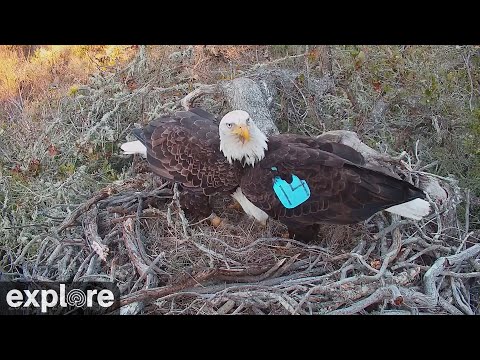
Highway cameras on the way in
- VISITOR CENTERSanta Rosa Island Visitor Contact Station2 mi SThe visitor contact station is open 8:30 am until 5 pm daily.
- CAMPGROUNDWater Canyon Campground3 mi SSanta Rosa Island campground is open year round.
- CAMPGROUNDSanta Rosa Island Backcountry Beach Camping11 mi SJanuary 1 - August 14 Backcountry beach camping is closed to protect pupping seals/sea lions and nesting seabirds.
Place information, alerts and photos: National Park Service (U.S. Government work). Weather: National Weather Service. Elevation: USGS. Map: Google Maps. US Road Cams is not affiliated with the National Park Service.