- ELEV
- 7,882 ft
- COORD
- 37.6409° N · 112.1705° W
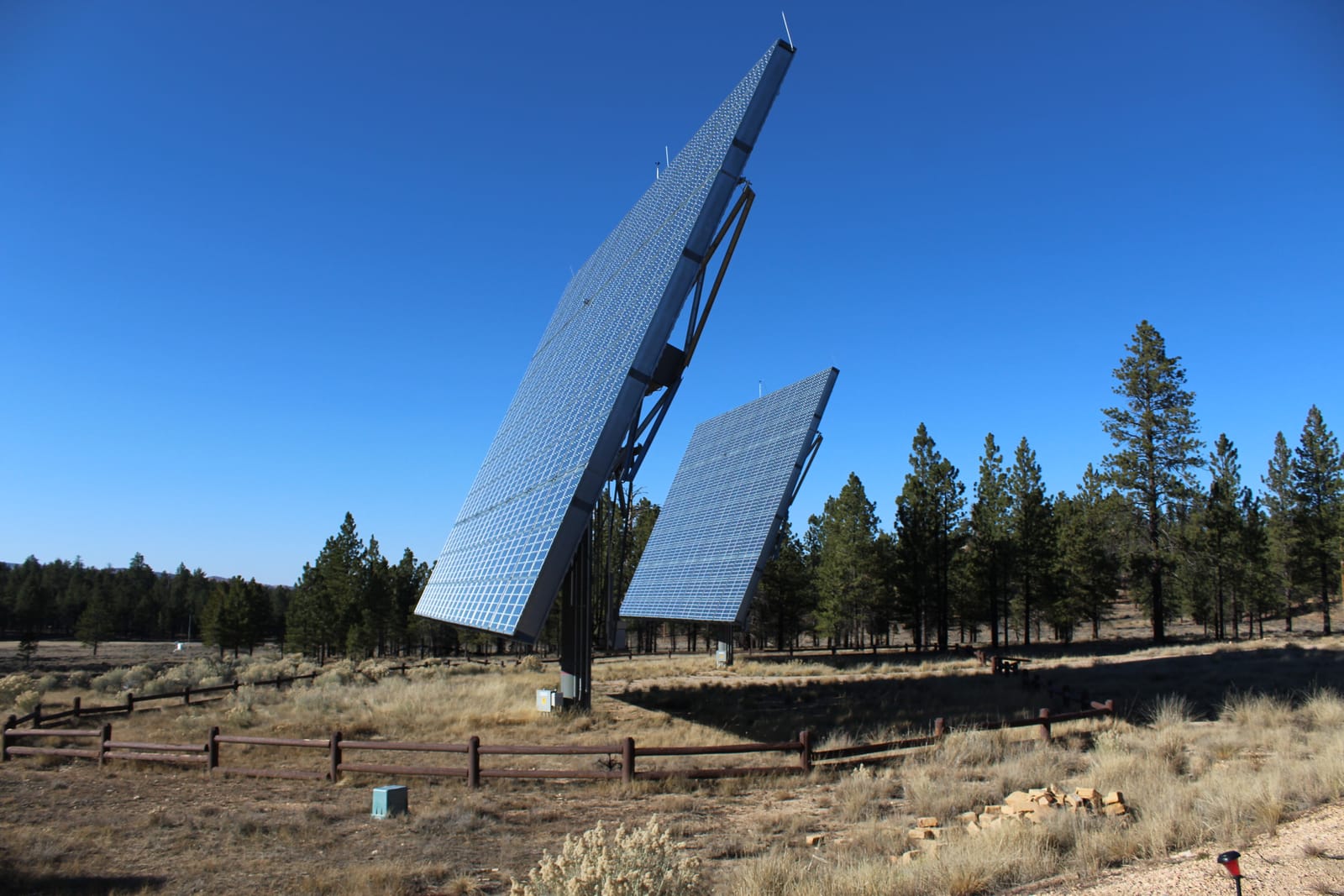
How it Works
The Bryce Canyon Solar Array consists of two dual-axis trackers that perfectly follow our Sun throughout each day during every season of the year. Such telescope-like precision is required because unlike regular photovoltaic panels, Concentrating PhotoVoltaic (CPV) technology does not generate electricity from ambient light. For the Fresnel lens to concentrate sunlight and for the tiny triple-junction chips to convert it to electricity, the sun alignment has to be within 1-2 degrees.
When installed in sunny locations, CPV outperforms all other kinds of solar energy, both in sunlight conversion efficiency and energy density (kilowatts / acre). Operating at 140kW per hour and peaking at 150kW, this array generates more energy than can be easily stored in batteries, so instead, excess energy is returned to the grid. On a sunny day, the array generates more than twice the energy the Bryce Canyon Visitor Center uses, providing us with an energy credit that can then be reclaimed at night or on cloudy days.
The Photovoltaic Cell
Each tracker consists of 5,040 individual solar collection cells. Sunlight enters each cell through a Fresnel lens, (commonly used in lighthouses to focus light into a beam) which concentrates sunlight through a reflecting chamber on to a tiny triple junction photovoltaic chip.
Because all photovoltaics perform better at cooler temperatures, the chip itself is mounted on a large aluminum heat-sink (similar to those used to cool computer processors) with blades that extend out of the cell, on the shaded size of the unit, where air circulation aids in further
Maximizing Solar Energy
Only half of our Sun’s energy reaches Earth’s surface. The narrow range known as optical light is what the human eye-brain combination uses. Through photosynthesis, plants convert 2-4% of solar energy into sugars. The best silicon solar panels are about 18% efficient. Concentrating PhotoVoltaics (CPV) technology focuses light onto triple-stacked photocells of different alloys. Each layer in the stack collects sunlight from a different part of the spectrum, that when added together, converts 34% of our Sun’s transmitted energy into electricity.
Other Facts
When wind speeds exceed 35 mph, each tracker’s anemometer instructs it to tilt back to the horizontal wind stow position where they can survive winds speeds up to 100 mph.
A clock drive allows the trackers to track our Sun even when cloudy. A sun-tracker in the upper center of each tracker adds precision when our Sun is out.
A pyrheliometer independently measures sunlight intensity and our Sun’s precise position in the sky to improve efficiency.
UV today 3 Moderate, peak 12 PM6°F cooler than normal todayPressure Rising ↑
Observed at Bryce Canyon Airport, 4 mi away, 8:30 AM MT. Source: National Weather Service.
Elsewhere in the park
- Park ClosureTrail Closure Due to Recent Weather
The Bryce Connector Trail (Bryce Point to Peekaboo Loop Trail) is closed until further notice. Other park trails are open, but hikers are urged to use caution. Freezing temperatures overnight can make rockfall more likely during the day.
NPS · checked Nov 23, 8:07 AM MT
Information Dump Station Closed for Season
The dump station has closed due to early freezing temperatures. Please make other arrangements. Drinking fountains are also in the process of being winterized for the same reason. Please plan appropriately.
NPS · checked Nov 23, 8:07 AM MT
This does not affect the road or Solar Voltaic Arrays. Alerts are matched by road name; check nps.gov to be sure.
Entrances
- Bryce Canyon Park Entrance Sign 1 mi NEOPEN
Highway cameras on the way in
- VISITOR CENTERBryce Canyon Visitor Center1 mi SEWinter hours are from 8:00 a.m.
- CAMPGROUNDNorth Campground1 mi SENorth Campground is open 24 hours a day, year-round, weather permitting.
- CAMPGROUNDSunset Campground1 mi SOpen April through October, weather dependent.
Place information, alerts and photos: National Park Service (U.S. Government work). Weather: National Weather Service. Elevation: USGS. Map: Google Maps. US Road Cams is not affiliated with the National Park Service.